
The 5thMark journal · Accounting history
A history of
accounting.
Told through the tools that helped us keep count.
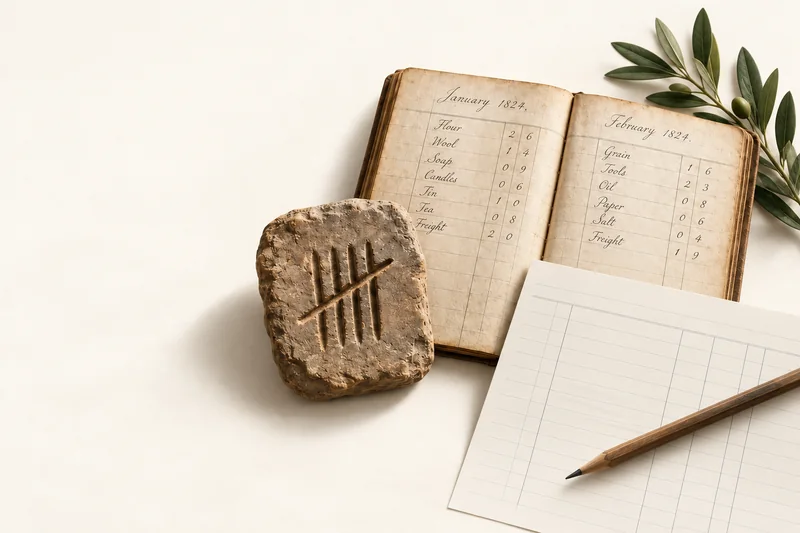
Accounting has existed for thousands of years because whenever people trade, own property, collect taxes, or run businesses, they need a way to record what they have, what they owe, and what changed.
Accounting through the ages.
Ten periods. An evolving set of tools.
| Period | Development in accounting | Tools used |
|---|---|---|
| c. 8,000–3,000 BCE | Early societies tracked livestock, grain, debts, and trade. |
|
| c. 3,000 BCE–500 CE | Mesopotamian, Egyptian, Greek, and Roman governments developed more organized records for taxes, wages, inventories, and commerce. |
|
| Middle Ages | Expanding trade required merchants to keep better records of purchases, sales, debts, and partnerships. |
|
| 1494 | Italian mathematician Luca Pacioli published a description of the Venetian system of double-entry bookkeeping—debits and credits recorded in a structured journal and ledger. He did not invent the practice, but his publication helped formalize and spread it. |
|
| 1600s–1800s | Growing companies, banks, international trade, and eventually the Industrial Revolution made accounting more sophisticated. Cost accounting, auditing, and financial reporting became increasingly important. |
|
| Late 1800s–mid-1900s | Accounting developed into a modern profession. Mechanical calculation and standardized business records greatly accelerated bookkeeping. |
|
| 1950s–1980s | Businesses began automating payroll, billing, inventory, and general-ledger work. Initially this was concentrated in large organizations. |
|
| 1980s–2000s | Personal computers transformed accounting. Spreadsheets and accounting programs made calculations, reporting, and recordkeeping dramatically faster. |
|
| 2000s–2020s | Accounting moved online. Bank feeds, electronic payments, digital receipts, and cloud platforms allowed records to update continuously and accountants to work remotely. |
|
| Today | Automation increasingly handles data entry, reconciliation, expense classification, reporting, and parts of financial analysis. Accountants can spend more time interpreting information and advising businesses. |
|
What changes. What stays.
New tools.
The same purpose.
The biggest change is therefore not the purpose of accounting but the tool used to accomplish it.
- Clay tokens
- Tablets
- Handwritten ledgers
- Mechanical calculators
- Computers
- Spreadsheets
- Cloud accounting
- Automation and AI
What once required someone to manually write every transaction into a physical ledger can now happen almost instantly when a bank transaction flows into an accounting system.
Yet the fundamental idea remains remarkably similar: capture economic activity, organize it, verify it, and turn it into useful financial information. Modern technology has changed the speed and scale of accounting far more than its underlying purpose.